
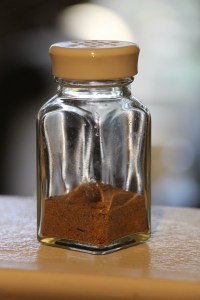
On my kitchen windowsill sits a Dollar Store saltshaker partially full of orange-ish dirt. Many mornings I don’t even notice its presence, but on the mornings that I do, I smile as it empowers me with secret strength and hope for my day. This little jar of “holy dirt” hails from Chimayo, New Mexico.
Over the past 3 summers I have made the journey to Sante Fe, New Mexico for The Glen Workshop; a Christian Arts Conference inviting artists and sojourners to explore art, faith, and mystery under a desert sky. The group of 200 or more come from within the wide reaches of the ecumenical Christian faith and explore dialogue that, although often challenging and foreign to me, echoes with the journey towards faith in God through an exploration of beauty.


Thursday was our day off at The Glen, and I had been invited to join a few newfound friends on a pilgrimage to El Sanctuario de Chimayo – a Roman Catholic Church and pilgrimage site deemed by Wikipedia as “the most important Catholic pilgrimage center in the United States.”
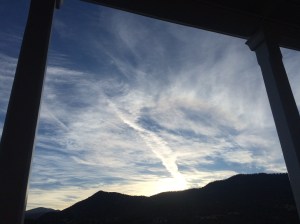
I awoke early and spent some time in the thin coolness of the birdsong-soaked air awaiting sunrise. I had heard whispers of Chimayo during my previous two years at The Glen, and was intrigued by this place where apparently crutches lined the walls announcing to the world of miraculous healings ascribed to the “holy dirt”. That morning, I did a Wikipedia search to find out more about this little town and pilgrimage site.
One of the legends (albeit simplified) is of a young friar who, in the early 1800s, saw a light shining from the hillside and, upon investigation, found a crucifix buried in the dirt. After three attempts to relocate the crucifix to a church in Santa Cruz, it always mysteriously ended up back in Chimayo. So, a chapel was built over the place where the crucifix was found, and later people started reporting miraculous healings attributed to the “holy dirt” in this area (hence the pilgrimages).
I am uncomfortable with relics and places ascribed with healing power, and yet, I was curious about what I would encounter in the mysterious high desert. After breakfast, we piled into our Texas-plated car and headed out onto the highway passing sagebrush dotted broken mesas. Our conversations deepened as the mesas gave way to deep, winding gorges along the Rio Grande and Santa Cruz rivers. Eventually we came to the dusty outskirts of the town of Chimayo.


As we wound our way down into the town and along a dirt road into the parking lot of El Sanctuario de Chimayo, I wondered how I should approach this site; as a tourist, or as a pilgrim. I climbed out of the air-conditioned car into the heat and decided I could be both. I would approach the area with quiet reverence and an open heart, and then take some photographs to help record and remember the journey.
The first thing I noticed were large hand-made crosses leaning up against a wooden fence. These crosses were carried, some from as far away as Albuquerque, New Mexico, during the Holy Week pilgrimage. Many of these wooden crosses were crudely made and most engraved with the names of loved ones, blessings, and the desire for hope and healing.


Adjacent to this wooden fence was a long chain-link fence covered in small crosses, rosary beads, and mini-statues – many handmade. A statue of Mary, draped in rosary beads, led the way along this path filled with remembrances of the prayers of the faithful. As I wandered along this path I was struck by the beauty of each untold story reflected in these items left affixed to the fence.


Just past the fence was the Prayer Portal, an open structure devoted to displaying the pictures and prayers of those who came to El Sanctuario de Chimayo in search of a miracle. My eyes glanced over the photos of loved ones, both young and old, posted on this wall, and again I wondered at their stories. So many told of tragedy and pain and yet reached out to God for healing and peace.


From the shade of the Prayer Portal we made our way back into the searing New Mexican heat, and wandered towards the actual El Sanctuario de Chimayo. The earth coloured adobe structure, with its bell towers, contrasted against the pale desert-blue sky. We meandered into the courtyard to the chapel entrance where a sign read, “No cell phones, no cameras, spend time with God.”


Once inside, I breathed in the beauty of this adobe church – the dark-wood crossbeams and pews, shimmering prayer candles, folk-art Stations of the Cross, and altar cloth and pieces. Two older women sat near the altar chanting the rosary in unison. We stood in silence and simply listened, unsure of what to do next.
A man approached and asked us if we wanted to go through to the room containing the “holy dirt”. We nodded and he led us past the chanting women and out of the main sanctuary to a small room on the left. The four of us entered the small adobe room together and gazed at the hole dug into the floor, complete with a tacky plastic yellow shovel, waiting for us to gather the “miraculous dirt”. The walls of the room were lined with framed verses, icons, and candles – most as tacky as the plastic shovel. A small window allowed sunlight to bathe the room in a soft orange glow. We each took turns with the dirt; picking it up, rubbing it in our fingers, each saying a silent prayer. I wasn’t exactly sure how to pray in this little room, but managed to mutter a few quiet phrases as I tucked a small shovel full of dirt into a folded piece of paper. (I hadn’t thought to bring a container with me to collect the “holy dirt”).
Once outside of the small dirt room we stood in an alcove lined with crutches, photos, and letters attesting to the miraculous healings people had experienced in this place. I didn’t expect any miraculous healing, but the experience did have a strange – “clearly this is out of my comfort zone” – level of sacred mystery to it.
We left the church, unspeaking, letting each person be alone with his or her thoughts and conclusions. As we wandered under the intense sun into the town above – I now began to photograph the church and its surroundings, a bit perplexed by the strange mix of the kitschy and sacred, but continually awed by the beauty of New Mexico.


The next day, during our Friday evening service, our spiritual director Deborah Smith Douglas spoke of her encounter with relics. In her homily, entitled “Burdens Lost, Chains Broken”, she told of how she had traveled to a church in Italy that claimed to hold under its altar the broken chains worn by Saint Peter. What caught my attention was when she revealed that her Presbyterian DNA didn’t know what to do with the notion of relics, but on that day, standing there, she suddenly realized that it didn’t matter if the broken chain relics were real or not, what mattered was what they represented; God’s ability to free people. She knelt and wept at the altar, realizing how much she needed God’s freeing power in her life. On that day, at a deep level, she realized that the altar built on broken chains became a sacrament – a glimpse of the liberating mercy of God.


This homily touched my heart as I realized that it didn’t matter whether a pile of dirt in a New Mexican desert had healing power or not. What mattered was what it represented: faith – the often gut-wrenching faith it takes to seek and trust God knowing that somehow, in the end, He holds the power of Story.
Over time, my tiny bit of “holy dirt” sitting on my windowsill has become a type of sacrament that makes me pause and reflect on the complex dance between faith and belief. It allows me to step forward and trust in the mysterious interweaving of my imperfect story with His Perfect Story. It reminds me to press into life and not be afraid – and, perhaps in this small way – this little jar of “holy dirt” has healing powers after all.
“Here is the world. Beautiful and terrible things will happen. Don’t be afraid.”
-Frederick Beuchner


 Seen. Known. Enough.
Leave a comment